The truck pulls out of Gondar before the city is properly awake, headlights catching eucalyptus smoke drifting off the rooftops. By the time the sun clears the hills, the road has already started climbing — through Wolleka, through wheat fields turning gold, up toward Debark, where the plateau ends and the Simien escarpment simply falls away into cloud. Somewhere past that first viewpoint, most travelers stop talking. It’s the moment the trip actually begins.
This guide covers everything you need to plan a Simien Mountains trek: the main routes and camps, when to go, how permits and park rules work, what a realistic itinerary looks like day by day, and what to pack. It’s written from years of leading treks on this exact ground, not assembled from a checklist.
Why the Simien Mountains Are Worth the Climb
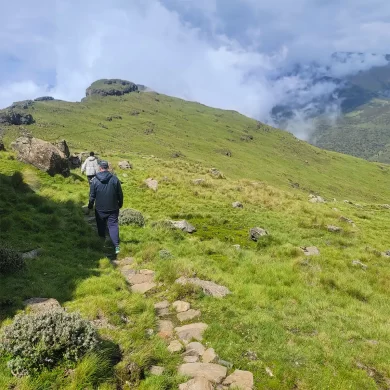 The Simien Mountains are what’s left after millions of years of erosion carved a volcanic highland into jagged peaks, table-top massifs and escarpment walls that drop more than a kilometer in a single view. UNESCO listed the park as a World Heritage Site for exactly this reason — it’s one of the most dramatic mountainscapes in Africa, and one of the few places on the continent where you can hike for days without leaving a designated wilderness.
It’s also one of the best wildlife walks in Africa that doesn’t involve a vehicle. Troops of Gelada baboons — found nowhere else on earth — graze along the escarpment edge in numbers that can reach several hundred, often close enough to sit quietly nearby. Higher up, the endangered Walia ibex works the cliff faces near Chennek, and if you’re fortunate, an Ethiopian wolf will cross a distant ridge at dawn. Lammergeier vultures ride the thermals along the rim most afternoons.
Best Time to Trek the Simien Mountains
The dry season, roughly October through March, is when the escarpment shows itself properly — clear long-range views across the plateau, firm trails, and cold but manageable nights at camp. Within that window, October and November stand out: the rains have just ended, so the highlands are still green and the waterfalls at Jinbar are running, but the skies have already cleared.
December through February brings the driest air and the coldest nights — temperatures at Chennek and Bwahit camp can drop below freezing, so a proper sleeping bag matters. April through September is the rainy season; trails turn muddy and cloud regularly closes off the views the Simien Mountains are famous for, so most operators, including ours, steer clients toward the dry months.
Main Trekking Routes
Nearly every itinerary starts and ends at Debark, the small park headquarters town about 2.5 hours by road from Gondar, where permits are issued and your guide and scout join the trip. From there, routes branch by how many days you have and how high you want to go.
3-Day Escarpment Route (Sankaber → Geech → Chennek)
The classic short trek. It covers the park’s most photographed sections — the Geech Abyss, Jinbar Waterfall and the Imet Gogo viewpoint — without pushing above 3,900m. It’s the right choice if you have limited time but still want the full escarpment experience with wildlife-rich walking each day.
4 to 6-Day Extended Route
Adds Bwahit Pass (4,430m), the second-highest point on the standard circuit, plus more time for wildlife watching and slower, less rushed days between camps. This is the sweet spot for most of our guests: enough altitude and scenery to feel like a real expedition, without the long summit push.
7 to 9-Day Ras Dashen Summit Trek
For trekkers who want to stand on Ethiopia’s highest point — 4,550m — this route continues past Chennek through Ambiko camp for the summit push, then loops back or exits toward Mekane Berhan. It’s a serious high-altitude trek that rewards a gradual, well-acclimatized itinerary rather than a rushed one.
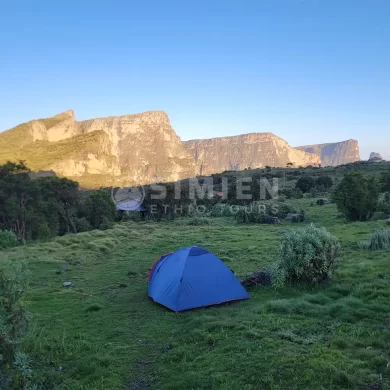 Camps Along the Way
Trekking in the Simien Mountains is camp-based — a mule team carries tents, food and equipment ahead of you each day, so you arrive to a set camp rather than carrying full expedition weight yourself.
| Camp | Elevation | Highlights nearby |
|---|---|---|
| Sankaber | 3,260m | First night; escarpment views, Gelada troops on the walk in |
| Geech | 3,600m | Jinbar Waterfall, Geech village, access to Imet Gogo |
| Chennek | 3,620m | Walia ibex territory, base for Bwahit Pass |
| Ambiko | ~3,200m | Staging camp for the Ras Dashen summit push |
Permits, Guides and Scouts
Every trek begins with registration at the Simien Mountains National Park headquarters in Debark. Ethiopian park regulations require a licensed guide and an armed scout to accompany every group inside the park — this isn’t optional and it isn’t a way to pad the cost; the scouts are part of how the park manages the boundary with surrounding farming and grazing communities, and guides are trained on route safety, wildlife and altitude.
How we handle it: Booking with Simien Ethio Tours means your park permit, guide, scout and mule team are arranged before you arrive in Debark — you walk straight from vehicle to trailhead instead of spending your first morning in paperwork.
Sample 4-Day Itinerary
Drive from Gondar to Debark for permits and briefing, then continue into the park. Short afternoon walk into Sankaber camp, with Gelada troops often visible along the way.
Full day along the escarpment rim past the Geech Abyss, descending to Jinbar Waterfall before climbing to Geech village and camp.
Sunrise detour to Imet Gogo (3,926m) for one of the best 360° viewpoints in the park, then on to Chennek camp — prime territory for Walia ibex.
Early climb to Bwahit Pass (4,430m) for a last high-altitude view across the range, then descend to meet the vehicle and drive back to Gondar.
What to Pack
- Layers: daytime sun is strong, nights at 3,600m+ drop near or below freezing (Oct–Feb)
- A sleeping bag rated to at least -5°C for December–February treks
- Broken-in hiking boots — trails are rocky and uneven, not technical
- Sun protection: hat, sunglasses, high-SPF sunscreen (equatorial sun at altitude is intense)
- Headlamp, refillable water bottle or bladder, basic first-aid and altitude medication if prescribed
- Cash in birr for tips — camps and Debark have no reliable card payment
Why Trek With a Local Operator
The Simien Mountains reward local knowledge — knowing which camp has water in a dry month, which pass to avoid in heavy wind, which ridge the geladas will be working that week. I’m Tesema, and I’ve been leading treks on this escarpment since founding Simien Ethio Tours in 2015. Our crew — guides, scouts and cooks who’ve worked these trails for years — handles the logistics so your only job is to walk and look up.
Plan Your Simien Mountains Trek
Tell us your dates and how many days you have — we’ll build a private itinerary and send a quote within 24 hours.